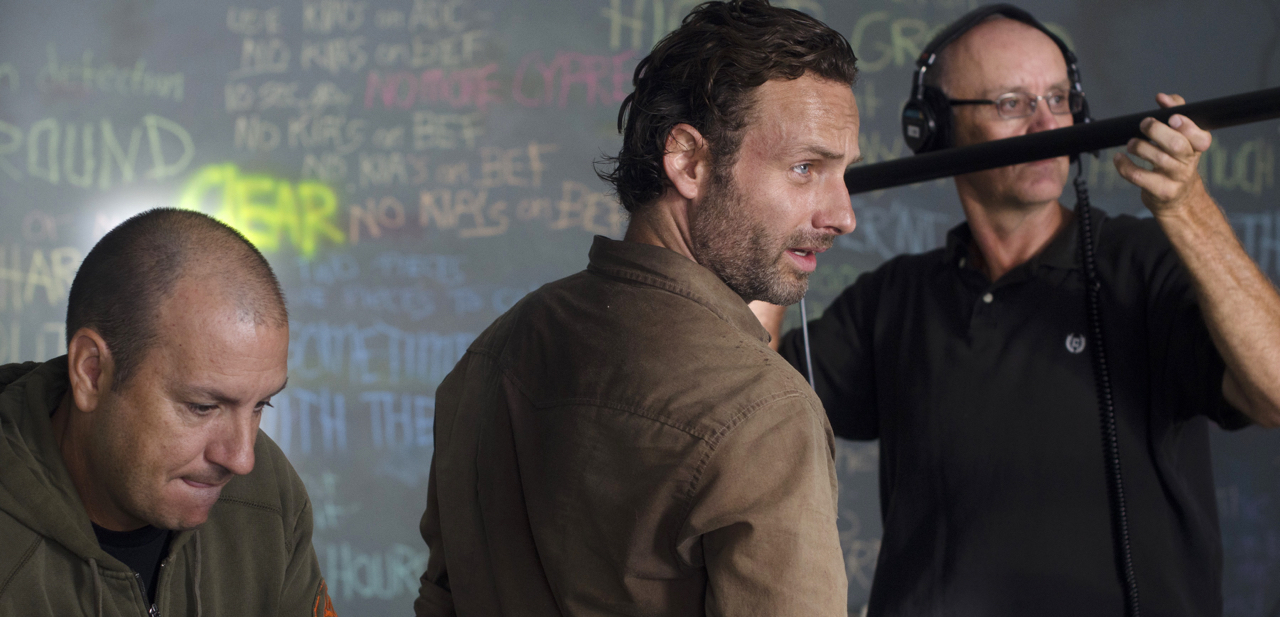
 How I came to work on the most prolific show in television history!
Did you know that chiggers don’t actually burrow under your skin?! Nope, they actually grab onto a hair follicle, and inject a digestive enzyme into your skin cells. That ruptures the cells so that they can drink the fluid which has a protein they need to grow. Your skin hardens around that area, forming a nice big red volcano-like sore. That volcano acts like a straw, so that they can suck out the skin cell fluids. One big red enzyme-filled volcano keeps you itching for a good three to four days! That’s so awesome! The bad news is, you almost never get bitten by just one! I came by this intimate knowledge of chiggers in the early Fall of 2011 when I was invited to go down to Atlanta for three weeks to boom a show I’d never heard of called The Walking Dead. It was in the middle of Season Two, and I was told that another guy would come in after me and finish the last five weeks of the schedule. It’s not a good sign when you take over in the middle of a season, much less when they’ve already scheduled another person to come in after you. Somehow, I couldn’t stop thinking that I was just another piece of raw meat for some zombie’s lunch. Also, I wasn’t the slightest bit interested in working nights on a project with blood, guts and gore, and I’ve never taken well to B rated horror movies. So, my first reaction was to say, “No thank you.” Besides, the more I thought about working with slimy creatures, the more I remembered my sappy experience back in the early 90’s on the TV series, Freddie’s Nightmares. It was an experience that was…well, yucky. So, after a short deliberation, I told the sound mixer, “Thank you for inviting me, but I’m going to have to pass.”
Well, seven days went by and I still hadn’t booked anything for the following week, so I thought, “Heck, three weeks with a bunch of rotting corpses in sunny Georgia couldn’t be too disgusting, and it’s not like I have to eat lunch with them.” So, like any Boy Scout film worker during lean times, I called the Sound Mixer back and asked, “…still looking for a good Boom Operator?” He said “Yes, come on down.” So I thought, “Oh well, they’re paying me housing and per diem, plus a box rental and rental car…I’m outta here!” After I hung up I couldn’t help but think, “…he can’t find a local boom operator
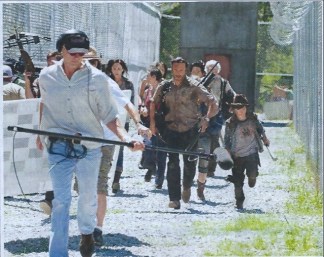 so he hires me out of Los Angeles, and it’s three days from needing someone and he hasn’t lined anyone else up?! This is odd!”
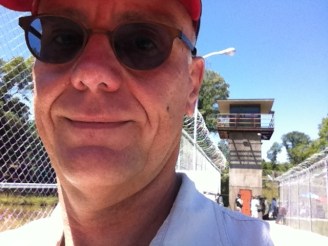
Three days later I was driving my rental car down a pitch-black country road at 6 o’clock in the morning, just outside the tiny rural town of Senoia, Georgia. The stages are situated in an old chemical plant on a dead-end road, one hour south of Atlanta in a thickly forested area that only chiggers could love. It’s shrouded by trees, stagnant ponds, railroad tracks, and all of the little creatures that make for a great horror flick. I fought off the feeling of this being my worst nightmare.
I arrived to some good news. They told me that I was the ninth Boom Operator on the show, since its inception one year prior. “You mean that in only 19 filmed episodes, you have been through nine Boom Operators?!” “Yep”, the Sound Mixer said. This was not sitting well with me. And it turned out, by the end of that same Season Two they reached the milestone of 11 boom operators!… a really bad sign. To this day they call me “Number 9, Number 9, Number 9….” Oh, and it turns out, I did have to eat with those zombie things. Nothing like lunch with a gooey corpse sitting across the table from me, spoon feeding itself through displaced dentures into it’s black and blue prosthetic face… yummy. But, it’s those little tufts of half dead hair that really creep me out.
The day before my arrival, they had filmed the Season Two farm scene where Rick, Shane, and the others, slaughtered the zombies that Herschel’s family had secretly kept in the barn. Our first setup had twelve cast members, spread twelve feet apart outside the barn, shud
 dering over the deaths of their kinfolk-turned-zombies. There were three cameras (a daily ritual), on three separate thirty-foot lengths of dolly track that formed a large U around the actors. All of the cameras had long lenses. I was the solo boom operator, as the six remaining Deva tracks were allocated to the scripted speakers and the mix track. It was my first day with this Mixer, so I hoisted the boom, danced about the dollies, and stretched with determination to prove to the sound mixer that I could get some dialog. For some strange reason, I wanted to stand out amongst the eight previous Boom Operators. My results seemed feeble, as I was only able to get a couple of lines. The Camera Operators and Dolly Grips were giving me funny looks like, “What’s with the new guy? What number is he?”. “Not the last,” said someone, “He’s walker bait…won’t last a week!”. They all chuckled. What the hell had I gotten myself into?
Far in the back of the acting pack was Beth (Emily Kinney), who sobbed uncontrollably throughout the scene. She was not wired, and yet dominated each take with her emotional outcries. I mentioned that it would be best to pull a wire off someone that I could get on the boom, and put that wire on her. But, the sound mixer and utility person seemed to not want to rock the production boat by taking the time to make the lavaliere transition. Later I was to learn that current efforts to improve the sound, had been tainted by unsavory events in the past, and that there were dictates from upper management that sound would be fixed in post. At one time on The Walking Dead, absolutely no booming was allowed. Radio mics were mandatory, and dialog would be fixed in post…period. They did not want to see any boom over the top of any actor, at any time. The sound mixer went on to tell me stories about how they would wait for “Roll Sound”, get the sticks, then at the last second sneak the boom in for some of the close ups. Booming this show is an apocalypse in itself.
As the 3rd take commenced, a loud jet entered the shooting zone. I immediately called for a hold, but the 1st AD cut me off, “We don’t hold for planes….roll sound!” The realities just kept coming. The remaining three weeks of my stay were grueling, uncooperative, sweaty, and filled with my first set of fluid sucking chiggers.
 t. Do you have any idea how much space is available in a tent after two cameras, two operators, and two assistants have been employed? Add in four apple boxes, and two 4 foot sliders, and it’s really cramped. And, do you know how much headroom is available in a tent? The only thing going for me was that they had to raise the side flap to position the cameras. There was barely enough room for me to insert a 12-foot boom pole with a MK41 capsule and GVC on a Schoeps power supply. I had to start the shot crouched down, yet standing, so as to reach the tent’s entrance. Fortunately, I was able to aim the mic straight through the fabric to bring them into the tent talking. I was just millimeters from the cloth ceiling, so I had to be extremely careful not to wisk the mic on the cloth, and at the same time keep the mic at an equidistance to their mouths. After they entered and began taking off their clothes, I had to back up and get down on two knees. I stretched and boomed the rest of the scene with the mic just one lousy inch from the ceiling. At one point, Rick delivered a couple lines looking away from Lori. I couldn’t possibly get them both, so I put a plant mic on a nearby table, and boomed Lori until Rick turned back. The plant did its job. And if it weren’t for some fancy side-lining, underneath work, and pointing through the tent fabric, we would have never been able to get the scene. Oh, and did I mention that it was the last scene of the night at about four o’clock in the morning? I was exhausted. It was truly my best booming feat during the entire three weeks. Let’s see, what have we been through; bloody zombies, not holding for planes, no-booms, chiggers, this number 9 thing, and now tents?! The Walking Dead just keeps pushing the envelope. But, as the camera operator, Michael Satrazemis said that first week, “It’s a tough show, but that’s what makes it great”. Obstacles and frustrations aside, I figured I better work hard, have patience, and keep a good attitude. Eventually I was able to get some support from the production staff, although I heard that after I left the show things went back to the way they used to be. The most support that I ever got, and the most the sound department ever got, was from the actors. They were fabulous. In fact, I remember the sound mixer telling me, when he was trying to entice me to do the show, that the actors were so very warm and accommodating, that it kept him motivated to do good work. People like Andy Lincoln (Rick Grimes), Norman Reedus (Daryl), Scott Wilson (Herschel), Irone Singleton (T-Dog), Jeffrey DeMunn (Dale), Lauren Cohan (Maggie), and Steven Yuen (Glenn), would come up to me and give me a good morning hug. I hardly knew
 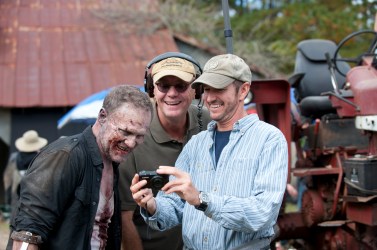 these folks, and they welcomed me like family. Jeffrey DeMunn (Dale) said it first, and he said it the most, “WE are The Walking Dead”. Dead.” WE, the cast, crew, and above the line above- the-line executives, ARE THE WALKING DEAD! It’s still true of the cast of The Walking Dead to this day. The Georgia heat, the remote locations, the grueling production schedule, the absence of zombie hygiene, and chiggers, make this a very difficult show, but the spirit that the actors instill keeps the crew working together as a team.
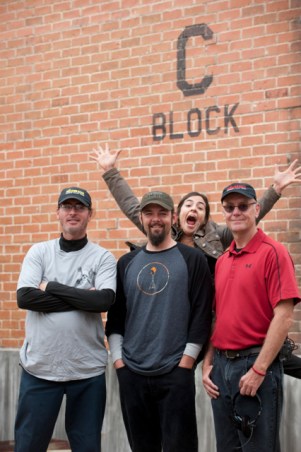
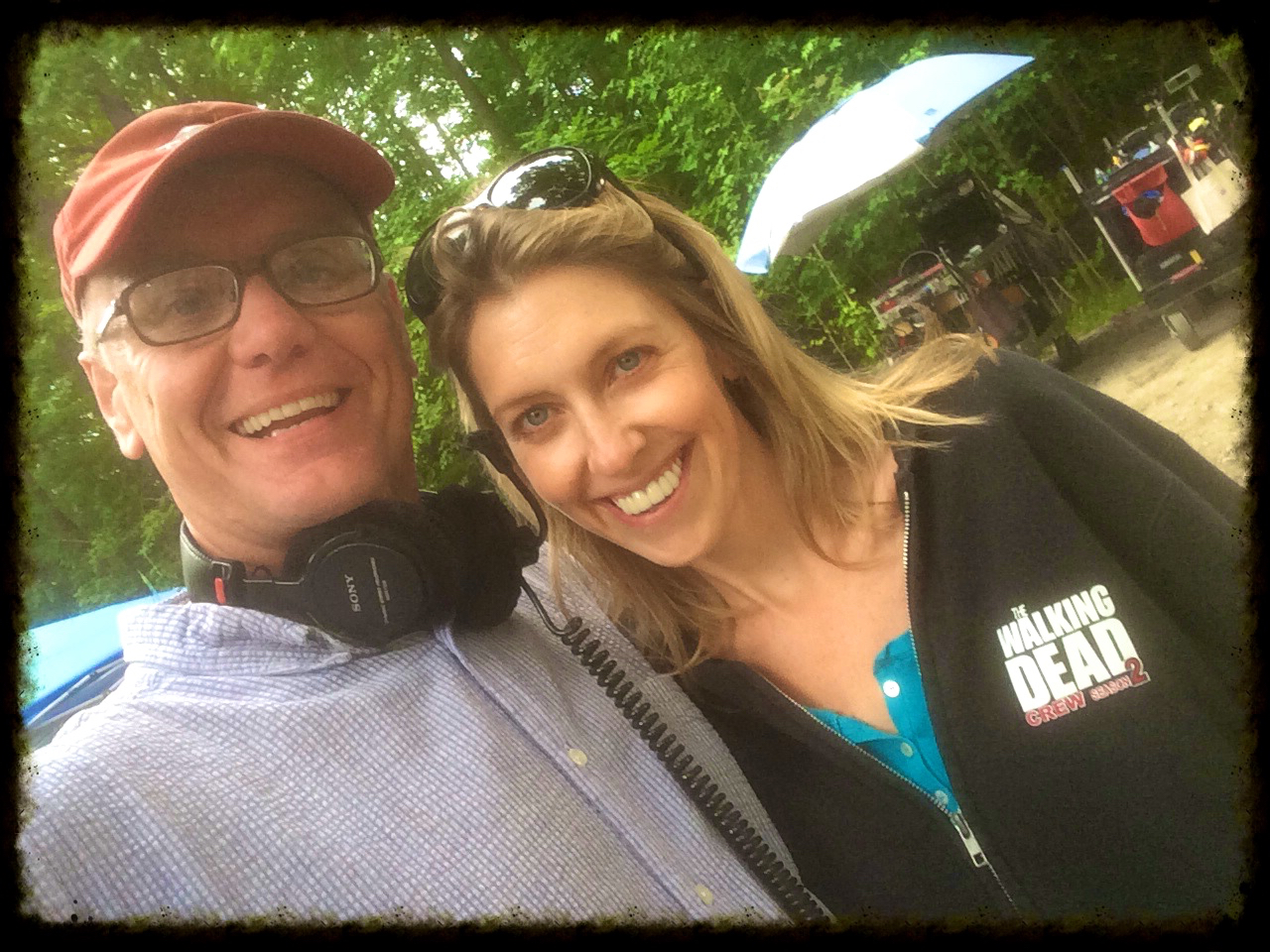 There has been a tremendous amount of growth and improvement in the sound tracks since the end of the second season. Now, we hold for most planes, boom a majority of the set-ups, and have the equipment to record 12-plus actors. But what really matters, is that we have the best sound team of which I have ever been apart. It’s been the same team since the middle of Season Three, and that alone has made a big difference. Production schedules are still hectic, so we still don’t get much of the cooperation we’d like on the shot selection, but we’ve learned to work with what they give us, and we never hesitate to ask for what we believe the editors need. We still get scenes with twelve actors, and the show will always be grueling, frustrating, bloody, and sweaty. But after all, what would The Walking Dead be like without disgusting zombies, filthy sets, dense forests, mud, snakes, ticks, chiggers, spiders, and formidable weather. Oh, and then there’s the blood….lots of blood…gallons of blood. In fact, there’s something like ten types of blood….live blood, dead blood, real dead blood, drippy blood, gooey blood, thick blood, blue blood, black blood, etc. It’s bloody unbelievable! Despite all of these extraordinary elements, the quality of the sound tracks have improved due to a solid pro-active plan, team work, excellent and ample equipment, and exemplary execution. Production Sound Mixer Michael P. Clark, CAS, leads us through the process by being very involved. Days in advance he will be analyzing scripts, talking with decision makers, preparing equipment, and contemplating solutions. And his mixing skills are sharp, clean, and logical. Dennis Sanborn, the Utility person, is assertively proactive with preparing equipment, securing locations, and most importantly wiring all of the actors. His adeptness and resourcefulness cannot be overrated, and he manages his area of expertise better than most utility persons in the business. Many of the locations are out deep in the woods, on rarely traveled dirt roads, dead railroad tracks, and around brush shrouded ponds. This means that we have to load our equipment onto flatbed trailers and get pulled by four-wheel drive vehicles to our locations. When the going gets rough, we all pitch in to get it down. And when a deluge of rain comes in at just that last moment of “Cut, Print, New deal….we’re in Stage 2 for Scene 27”, it is then that we have to buckle our prides and take the hit on another sloppy mud fest, to get ourselves out of the forested swamp bog.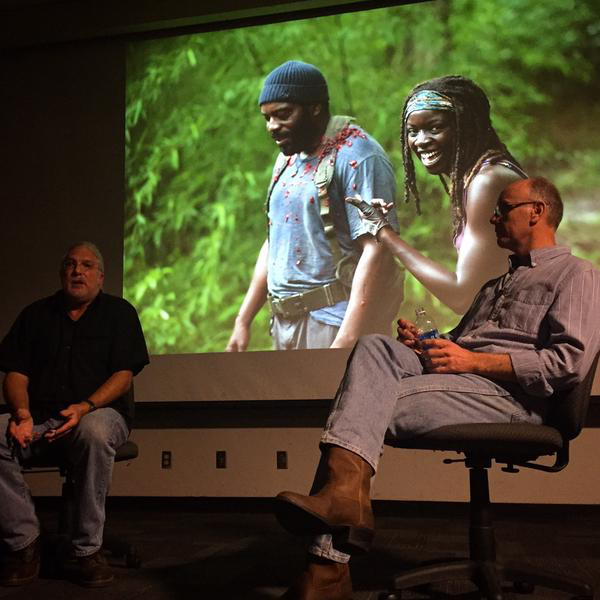
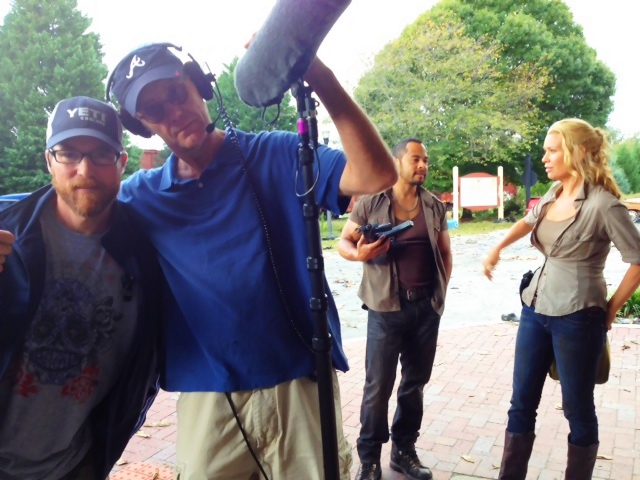 Anyone who has viewed the show is well aware of how location-driven the sets are. We work in the forest a lot. We work on gravel roads a lot. We work in fields a lot. We work with the elements a lot. But we also work a lot indoors. The difference is, 99.9% of our locations, wherever they may be, are filthy. They’re dusted, shredded, destroyed, trashed, wetted, burned, and pillaged. The only good thing about them, as far as sound goes, is that they are typically vacant and out of business. The turning off of noisy appliances is not so much an issue with us. It does mean that we have a dirty job. Everything is dirty on The Walking Dead. Oh, not that it’s related to booming, but, you know those out-of-service railroad tracks we’ve been working on? Well, the construction department built numerous wooden carts so that the various departments could transport their equipment down the rail lines. Problem is, they weren’t highly engineered and thus they break down regularly. And did I mention that they don’t have motors?! Nope, we have to push them. We push them for long distances…and they break down, so then we have to pull our carts off and roll them in the gravel and dirt along the railroad tracks. It’s really fun. It’s not unusual to have to roll them a half a mile down the tracks, after all, zombie apocalypses don’t happen next to Walmart. Another really cool thing is that we use these highly engineered wooden carts for dolly moves. No problem right? Well, they squeak….they squeak a lot…and they wobble…they wobble a lot. Now, when we shoot these scenes on the tracks our actors have to stumble across the railroad ties and shuffle through the gravel. Guess what, our dolly grips that push the carts with the dollies, shuffle through the gravel too. Listening to that noise fest is delightful. I suspect the most fun we have on the show is working with the multitude of props. Yes, more than any show I have worked on, or watched on TV, this zombie slaughtering apocalypse offers up a bevy of killing devices. And because the actors have to carry these weapons, along with their other survival gear, we have the honor of dodging them with little radio microphones. It’s never easy, and it never ceases to amaze us how many new devices they come up with, but somehow we manage an extra trick or two to over come overcome these obstacles. We utilize every imaginable trick in the book we have, from installing multiple lavalieres on their bodies, to collar rigs, hat rigs, hair rigs, prop rigs, or no rigs at all. That’s where I come in. I’m the boom operator, so I get to pull every imaginable trick out of my bag to get the microphone close enough to record something resembling good sound; an assignment that draws on everything from my booming repertoire. I’ve executed more outlandish and awkward moves on The Walking Dead in two seasons, than I have in my entire 28 year career in Hollywood.
 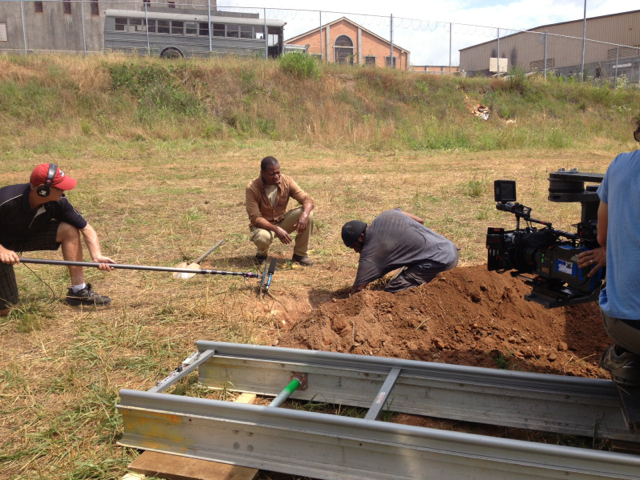 Other than the scads of intruding props which the actors carry and wield, what makes installing lavalieres difficult is….the shear volume of filth. In fact, the costumers go to great lengths to pat them down with blood, dust, dirt and oil. The blood and oil are the real test. As much as we all love Joe’s clear butyl, it doesn’t work on bloody and oily clothes. Perspiration doesn’t make such a good friend either. Because of these necessary treatments, we end up having to sew most of the lavalieres onto their clothes, especially during the warm months. This takes extra time. Fortunately, over the seasons we have conditioned the production staff to bring the actors to us extra early. The unfortunate thing is, once we’ve sewn them in, they have to be un-sewn whenever there is a technical issue with the lavaliere, or because of a wardrobe change during fight scenes, etc. Also, when there is excessive clothing noise, we have to ask for the time to remount them in different places. To help avoid the need for re-sewing, we do tests where we place the mic in the proposed position and have the actor go through his anticipated body motions. Sometimes we’ll wire additional wardrobe in advance. We’ve wired as many as three shirts at one time. Pre-planning is imperative, because we almost never do rehearsals, and time is so precious. Of course all lavalieres have to be cut out once the actors are wrapped for the day, and boy do they love waiting on us to go home, after a grueling day of rolling, running, and fighting their way through the zombie laden apocalypse! Not really.
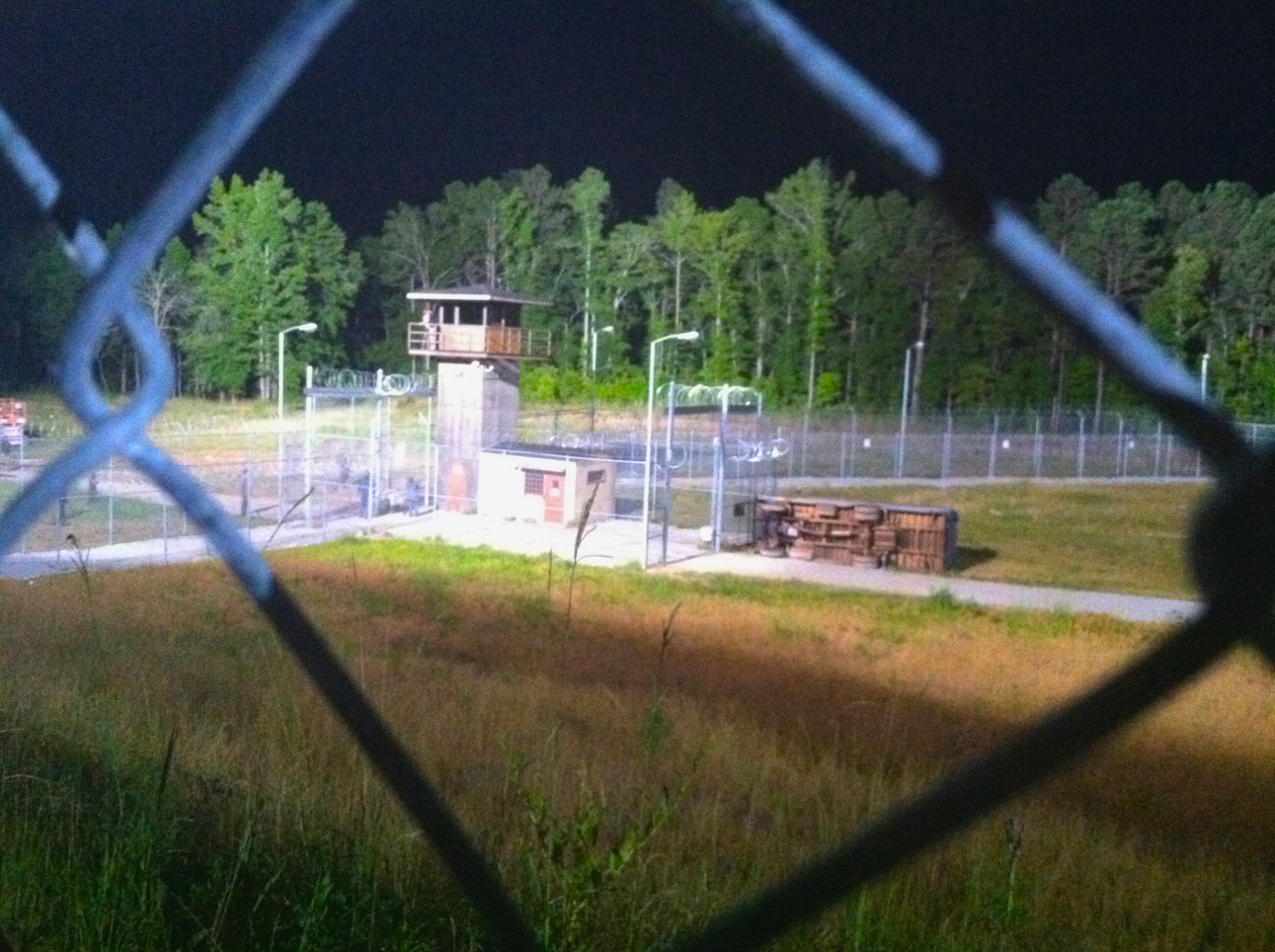 The way in which the show is photographed always makes for a tall task. I remember shooting Episode 405, “Internment”. The director, David Boyd, who is one of the former DP’s on the show, believes in a gorilla filmmaking style which incorporates multiple cameras in obscure positions. The episode takes place mostly in the prison cells, with Herschel (Scott Wilson” tending to the near death patients, particularly Glenn (Steven Yuen). Now, in reality these cells are only 10 feet by 10 feet wide, with a bunk bed on one side. So, it was common to shoot entire scenes in these cells with three cameras, two operators, and three actors. When possible, there was me. And ‘me’ needed to be there, because they, the actors, had blood on their chests, air masks in their faces, and crumpled up clothing to boot. Typically I would be sitting or standing on the upper bunk bed, or smashed up against a wall with an operator. Always, I was inches from the talent. These same cells were apart of our biggest acoustic challenges. Although they were prison cells, and thus wanted to sound like prison cells, they were really made of wood. And they sounded like…wood. We employed furniture pads on the walls, and acoustic tiles in the corners when they wouldn’t be seen, but many times we couldn’t. Fortunately the reverberant effects that post production added, fixed the problem, and made for some very interesting character effects to the scene.
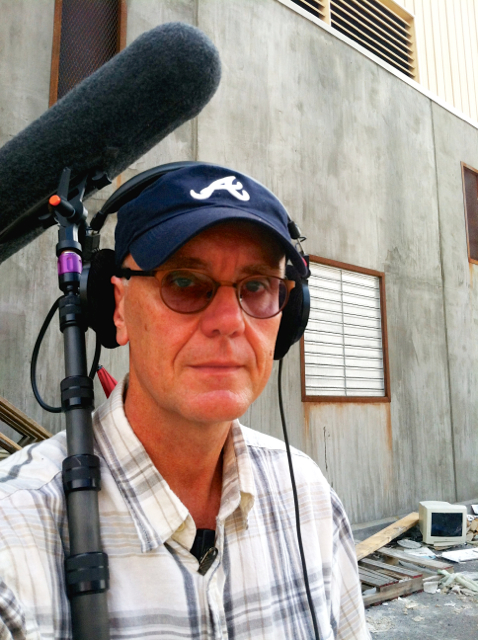 Despite all of the odds, discomforts, and long days in rural Georgia, we manage to get great sound. I’ve never witnessed a department that brings so much to the table as Michael Clark and Dennis Sanborn do. As arduous as recording sound is on The Walking Dead, these guys step up to the challenge of working on one of the most difficult shows in television. They face it head- on with persistence and determination. They execute the work with grace and good attitudes. Perhaps it’s the fact that it’s the number one show on television, perhaps it’s our own personal challenges, the truth is, we all get up every morning knowing that it’s going to be another tough day. We also know we’re not going to be facing adversity alone, we’re going to have our team, we’re going to have our well oiled comrades around us…and we’re going to be with our friends. There’s nothing more bonding than working on a show like this, a show that makes you better. Isn’t that what it’s all about….getting better, working as a team, and working with friends. The Walking Dead is a tough show, but that’s what makes it great!

Pingback: Blood, Guts, Gore…and Chiggers | Juli Hall Photography
I really love this, Robert! Some of the stories and points you mention in this post are points you made when I had the pleasure of seeing you and Gene Page speak a few months back…I remember those stories and points because they never left my mind from that night on! You, Gene, and the rest of the TWD writers, production, cast and crew have crafted this show, over the past 5 seasons, into an artistic tour-de-force, and do your jobs so well that the show has become incredibly real to the millions of viewers who love it so. Thank you, and the entire TWD crew, for what you do. It has inspired me, and many others, to reach into ourselves and explore our own creativity, whether it be writing a blog, creating social media posts and memes, painting/drawing/rendering favorite characters and themes from the show. The Walking Dead, both the comic and television series, has evolved into an unprecedented pop-culture phenomenon, and I am both honored and, at times, humbled, to be a “sometimes sideline reporter” for our fave show. Cheers!
LikeLike
Hey, thanks! Keep up the good work!
LikeLike
Incredible! Just an average fan with no knowledge of behind the camera happenings. You have enlightened me to appreciate so much more about my favorite show! Thank you! Loved reading this!
LikeLike
Thank you Linda! There are many more stories to come!
LikeLike