For over 30 years I have witnessed what actors go through to create characters. From where I’ve been standing, which is inches away, they use whatever available inside and outside tools they have to create an honest and captivating human. They are humans, after all, and they portray real people. So they have to be honest, as in real, as in they have to become that person, or character. It’s funny how on set they will have discussions with the director, and actually refer to their character in the third person…as if they are separate from that character. I’m always tickled by that, and just wanna say, “You are the character, you are that person!” But you see, they create that character as if it’s someone else, and so doing they relate to and become that human. They have to be real honest with themselves to achieve such greatness. They cut their hair, put on, or take off makeup. They wear applicable clothes. And interestingly enough, the department that dresses them, the one we call ‘Wardrobe’ prefers to be called ‘Costumes’. I tell them that I think costumes are something you wear out for Halloween, but somehow they are not amused. And now I have to stand corrected, as one of the definitions of ‘Costume’ is, “an outfit worn to create the appearance characteristic of a particular period, person, place, or thing” So motion picture actors wear ‘Costumes’ to support them in becoming the very character which hopefully you see as a real human being. You think that they are real! The better the portrayal the more you think that that character is a real human. You relate to that character because the actor did such an amazing job of becoming that person, and because you relate to the subject matter. Yep, the more you relate to the character, the more your own life parallels that character’s predicament. You gotta love show biz!
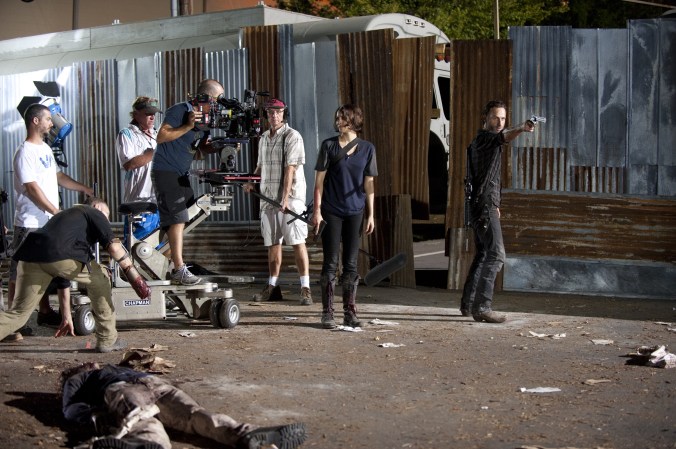
To support them in creating an honest and real character, and to best tell the story, they use props and set pieces. But what you may not have considered is that they also use their environment; the weather, the location, the lights, the camera, and even the sound. They may even use the tension in the air, or the pastoral calm in the setting. Whatever they can wrap their brain around, or emotions around, they will grab onto it and use it as a tool. It’s all about honesty, and they’ve got to be as real as that character can possibly be. You love them when they excel at this commitment on their part. You thrive on their struggles and triumphs.
Think about the challenges they go through under all of the extreme circumstances in which they work. They have to overcome so many obstacles, environment and otherwise, to stay true to the honest and realism of that particular character. I admire the hell out of them for their accomplishments. They use every tool available to them! Especially world class actors like Andy Lincoln. I’ve seen him walk around the room, smell the air, stroll through the woods, roll in the dirt, intentionally stand out in the sun and sweat, allow himself to freeze his rear off, and whatever else it requires to create the most honest and real Rick Grimes he can possibly achieve. It’s a remarkable process to experience. I wish you could see all of the outtakes that never make it into the show.
The lights, camera and sound are tools as well. In fact, we work directly with the actors on these elements so that they can maximize the technical aspects of their characters and the story.. Personally, it’s a part of my job to communicate to and with the actors about the problems related to the sound track. For starters, if we can’t hear, or understand what they’re saying, then frankly, you’re not going to understand their words either. I usually ask them to add a little clarity, not volume. I believe we need to understand them, not necessarily hear them at a higher volume. And at times, depending on the environment, we do need to raise their volume so as to improve the quality and quantity of the message. If a door slams at the same time one of the actors is delivering a key piece of dialog, then that can interfere with you understanding, which then sacrifices the story points, and so I have to address that with them or the director. If the hidden lavaliere microphone on their body is being muffled, because of a gun strap or coat is covering it, then we work with the actors, or props, to uncover or expose the microphones. It doesn’t always come across this way on set, but the truth is we’re requesting these changes because it’s what’s best for the character and the story line. At the end of the day, creating a motion picture is all about team work, and nobody does it better than The Walking Dead Family.
The lighting department does its part by setting the lights in a very specific manner so as to maximize the quality of the image, and such that it most dramatically supports the actor’s characters and the story. Each light is chosen carefully for it’s luminance levels and color temperature. They are placed precisely at the right distance and angle to the actor. A really good and well trained actor knows that the craft of acting involves knowing exactly where the lights are, and thus makes decisions while rolling that ensure he or she is in the appropriate light, at the pre-determined spot, at the correct time in the scene. The camera department accomplishes this by using tape marks, or ’T’s’ on the floor, for them to hit. They’re for lighting and camera, but they help me a too. In fact, my performance and ability to capture their dialog with my microphone is increased significantly when I know precisely where and when a particular line of dialog will be delivered. If they “hit the marks”, then a lot of us are much more able to deliver a compelling image and sound quality to the motion picture. Fortunately The Walking Dead excels in both of these categories.
The camera, and it’s related Dolly, also have very specific targets in which they need to hit, if they are to correctly frame the actors. Many times an inch or two off of a mark can make the difference as to whether their framed appropriately, or not. And it is not unusual for us to re-do takes, because either the camera nor the actors were on their marks at the appropriate time or place. It’s just a normal part of our daily process. And on The Walking Dead we typically nail-it.
I could say so much more about what actors go through to provide you with an award winning performance, but suffice it to say, for them to create an honest compelling character that drives you to the edge of your seat to want to experience more, then they must use every imaginable tool available to them to do it. The reality is, it’s not just what’s inside them, it’s what outside them that matters too. Welcome to show business.
 Robert K Maxfield
Without a doubt!
LikeLike
Wow… I think when everybody work together, has its rewards … #TWDFamily is more than a big family, and this is reflected in the final product that reaches the screen of all fans, within and outside their country … It’s great!
LikeLike
Teamwork…”We Work” is always more productive and rewarding. We create ‘Highs’ everyday!
LikeLike
Great read Robert…thanks for sharing..I loved it!
LikeLike
I love how you describe the actors using the elements around them to get into character as well. I think people overlook some of those small details because they are just so captivated by the finished performance.
What is it like for you with sound? Anything you do that maybe most of us wouldn’t think of? 🙂
LikeLike
Keep reading my stories and you will venture into my world of wonder.
LikeLike